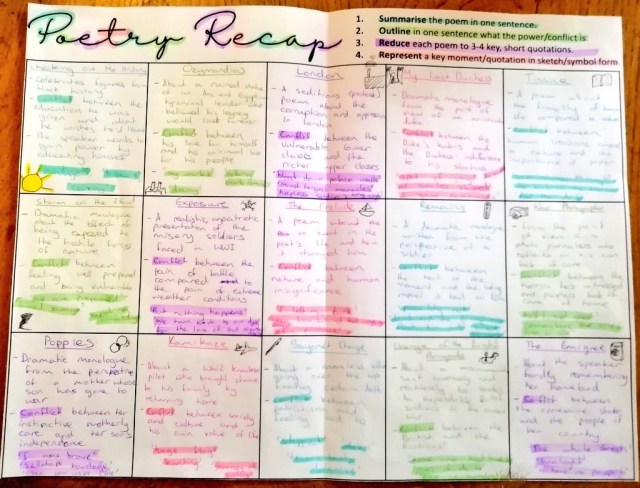
“This simple sheet lasted a whole Y11 double and the revision and thoughtful discussions it provoked were pure joy to listen to” from @MissMFrost
A place to share ideas and improve teaching and learning for learners in college and hopefully beyond.

“This simple sheet lasted a whole Y11 double and the revision and thoughtful discussions it provoked were pure joy to listen to” from @MissMFrost
They are a great idea and this takes the idea a little further
From the TES:
The key to the meaning of life, it turns out, isn’t 42 – despite what The Hitchhikers’ Guide to the Galaxy may tell you. As far as students taking GCSEs are concerned, the magic number is, in fact, 700.
That, according to new research published just before Christmas, is the number of words they should write in answer to essay questions in order to obtain maximum marks.
The research, by Tom Benton of Cambridge Assessment, shows that the relationship between words and marks flattens out at around 700.
Below 700 will get you a lower grade – almost every candidate who wrote 200 words or fewer ended up with a U (traditionally regarded as a failure) whereas those who wrote more than 700 words did not necessarily get higher marks. The research looked at 5,000 scripts from the OCR GCSE English literature exam in 2014.
The conclusion from the research was that if you write less than 200 words, you haven’t written enough to show off your knowledge, whereas if you write more than 700 words, it is possible that you are being too verbose.
Explicit Vocabulary Instruction as a Whole-School Literacy Strategy
Whole school vocabulary training idea from Durrington
Signing up for drop box is free and it is full of useful resources if you know where to look…
https://www.dropbox.com/s/1g4rlhwufpe4ct1/keyworddisplay.pptx
 Norton College Teaching and Learning Blog